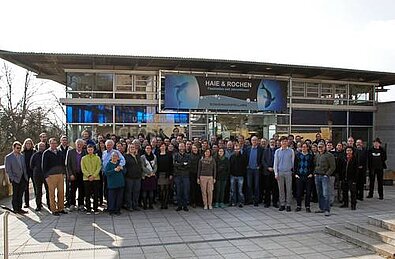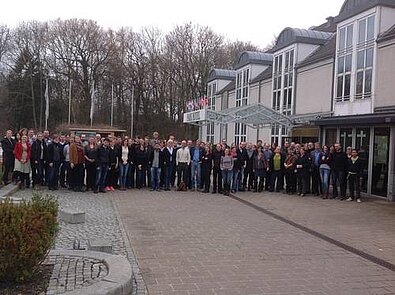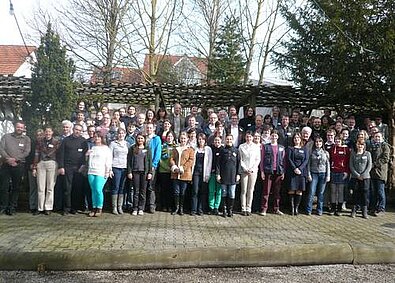

The research group Vertebrate Paleontology in the Paläontologische Gesellschaft has now been in existence for almost 40 years. It unites the vertebrate paleontologists in an informal group, which has neither permanent members nor a chairman! Thus, the working group may not exist in the legal sense and may not have a binding structure, which does not, however, affect the activities of the research group.
The research group is intended to strengthen the personal contact between active vertebrate paleontologists in the German-speaking areas and neighbouring regions. This is connected with the mutual information about own scientific work, excavations and joint projects. The exchange is concentrated on the annual meetings, each of which focuses on a topic from the common areas of interest. The topic will be determined at each conference for the following year. Mostly, however, a certain space for free themes remains beside the frame theme. In the course of time, these meetings have become the most important information exchange within the vertebrate paleontology of Central Europe.
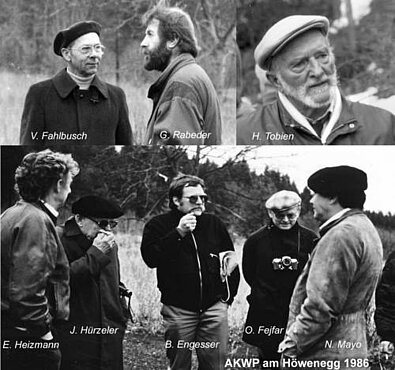
All colleagues from German-speaking and neighbouring countries who are active in vertebrate paleontology are welcome to the annual meetings in spring. The working group was founded in 1974 and was supervised by Prof. Dr. Volker Fahlbusch, Munich, until 1994, and then by Prof. Dr. Wighart v. Koenigswald, Bonn. - The meetings are organized on a voluntary basis by those colleagues who are closest to the planned meeting place.
First the working group met during the annual meetings of the Paläontologische Gesellschaft. Since 1976, independent meetings have been held every spring, usually on a weekend in March from Friday noon to Sunday noon. The meeting place changed in order to distribute the efforts of a long journey evenly. In earlier years every second symposium could take place at the Reisensburg near Günzburg. When the number of participants exceeded 100, this very nice tradition had to be abandoned. In order to offer a lot of time for discussions and personal conversations besides the conference program, conference venues are selected as far away from large cities as possible.
Initially, the working group was strongly focused on mammals and especially on their dentition, as this was the main field of employment. The application in biostratography played a major role in this. The clarification of the terrestrial biostratigraphy of the Southern German Tertiary would certainly not have been so successful without the contacts in the working group - intensive, often heated discussions regularly took place on questions of evolution as well as functional reconstruction. Prof. Gutmann from Frankfurt played an important role in this. - Zoologist Prof. J. Niethammer from Bonn, Germany, regularly attended the meetings and opened the view to the zoological aspects of vertebrate palaeontology. In the first years, access to meetings was kept somewhat restrictive. Participants should have a doctorate in order to keep the meetings small. But the meetings proved to be the ideal opportunity to broaden one's own horizon. We've all learned from each other. Therefore, soon PhD and diploma students, and finally all those interested, could participate. However, this went beyond the scope of the Reisensburg and the meetings increasingly took on the style of conferences.
In the 80s a great interest in dinosaurs arose worldwide. Because the working group focused on mammalian topics, a second interest group was formed which dealt specifically with reptiles and met - even less formally - separately as "Palherp" since about the beginning of the 1990s. Some personal reasons may also have played a role in this separation. - At the annual meeting 2011 both groups will meet again together in Eichstätt.
Paläontologische Gesellschaft e.V.
c/o Senckenberg Gesellschaft für Naturforschung
Senckenberganlage 25
60325 Frankfurt am Main
Tel: +49 157 806 706 78
Email: info@palges.de
Internet: www.palges.de